Menu

The history of public transport in Romania

Documented milestones in the development of public transport in Romania, from the first tram services to the current metro extension projects.

Transport stories

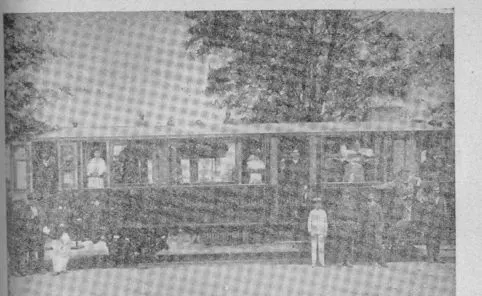
The steam tram on Calea Griviței, 1906, with passengers at the windows and staff in front of the car
The "steam" tram on Calea Griviței, between Gara de Nord and Sfântul Vineri cemetery, 1906 · Photo: period photograph, reproduced in Al. Cebuc, 1962, p. 139, public domain

1906

The steam tram was allowed on the tracks, provided it did not disturb the horses

In June 1906, Bucharest briefly had a steam tram. The company operating the horse-drawn trams agreed that a "steam railcar" could run on its tracks for about two kilometres, between the Sfântul Vineri toll gate on Calea Griviței and Gara de Nord. The city hall granted the authorisation on 26 July 1906, for one year.

The conditions show clearly who had priority. The concessionaire wrote to the vehicle's owner that the service had to run "without disturbing our horse service". The steam car had to keep at least 50 metres behind the tram in front, stop and start together with it, and carry only through passengers, at a fare of at least 20 bani. It paid the company 2 bani per passenger and the municipality 20 bani a day for each seat. The authorisation was declared "precarious" and could be withdrawn at three days' notice.

The tram ran for one year. After that, the records fall silent: historian Alexandru Cebuc, who studied the city hall file, found no further trace of it, and the reason it was abandoned is not recorded. It remained the only attempt of its kind in Bucharest.

Sources 49
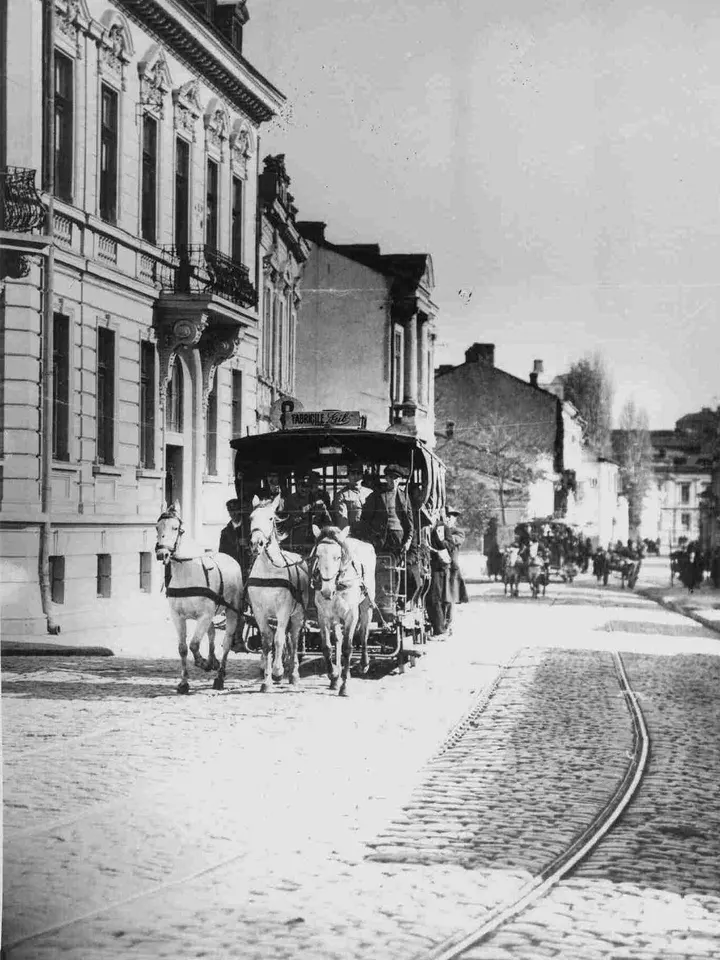
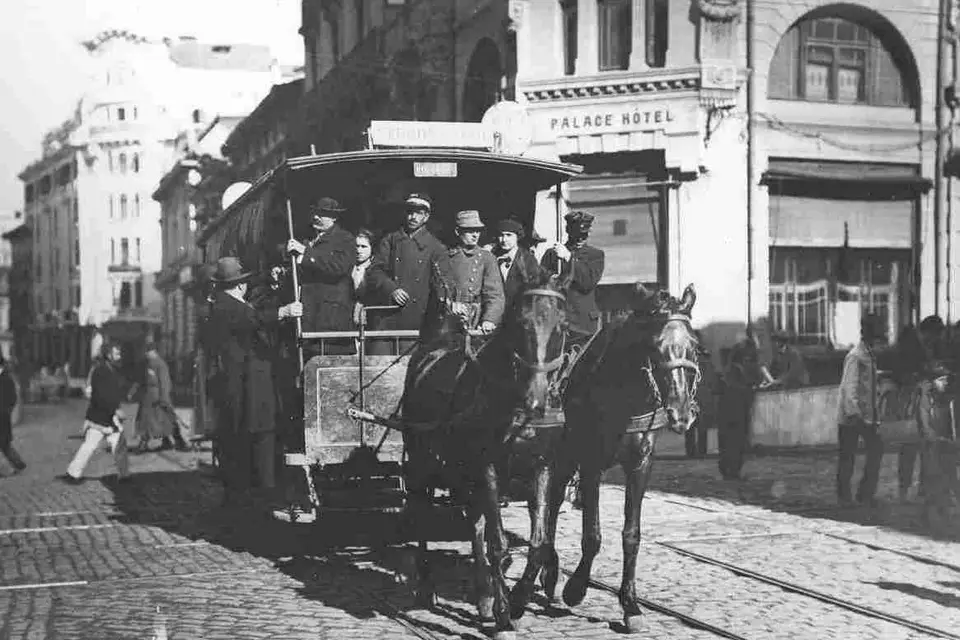
Tram drawn by three horses on Știrbei Vodă Street in Bucharest, with an advertisement on the roof
Horse tram on Știrbei Vodă Street, period photograph of uncertain date · Photo: unknown author, Wikimedia Commons, public domain

1927-1931

The horse tram stopped wherever you liked. The electric one made you run after it

Until the late 1920s, Bucharest ran electric and horse-drawn trams side by side. By 1927 only lines 5, 9 and 10 were still horse-drawn, and by 1929 animal traction had almost entirely disappeared. For a city that wanted to be modern, this was progress. Not every passenger welcomed it.

A text by Henri Stahl, a historian of Bucharest, quoted in a study published by the Bucharest Municipal Museum, sums up the complaint. The horse tram, he writes, "stopped wherever you wanted": an officer could send his orderly to hold it until the lady had put on her hat. With the electric tram, to find out where the stop was, you had to wait for a car, "run after it and, if you missed it, remember where it stopped".

The problem was real: stops were neither marked nor equipped. The study shows that the tram company took action, and its 1931 annual report recorded the first 9 pairs of passenger refuges at stops, not enough, but "a promising start".

Sources 50

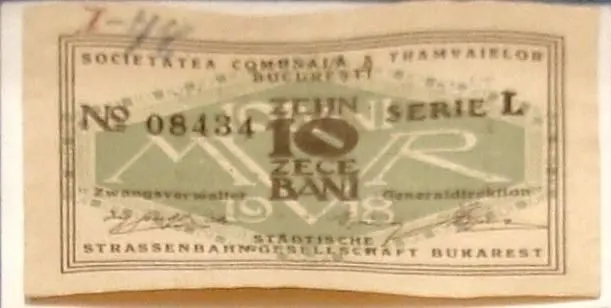
10-bani tram ticket of the Bucharest Municipal Tramway Company, 1918
Tram ticket from 1918, before travel classes were introduced · Photo: Strainu, Wikimedia Commons, CC BY-SA 3.0

1927-1936

First class on the tram cost one leu more. Second class had wooden benches

From 1927, the Bucharest Municipal Tramway Company introduced travel classes. The fare depended on the route and the class: first class cost between 4.75 and 7.75 lei, second class between 3.75 and 6.75 lei. On every route, the extra comfort cost exactly one leu.

What passengers got for that leu emerges from an account by Geo Bogza, published in 1953. Second class was in the earliest type of trailers, "with two wooden benches along their length". The effect on passengers' budgets is recorded just as precisely: those who meant to save money gave up at the sight of the old trailer and boarded first class.

Differentiated fares were nothing new. Tickets had been sold by fare sections since 1912, and in 1924, on the electric lines, prices ranged from 2.75 to 4.75 lei, plus 25 bani for the city hall. In 1927 there were general passes at 480 lei and reduced passes for pupils, civil servants and pensioners. From 1936, monthly passes also carried a 2-lei charge for the National Aviation Fund stamp: the daily tram ride contributed, month after month, to the country's aviation.

Sources 50

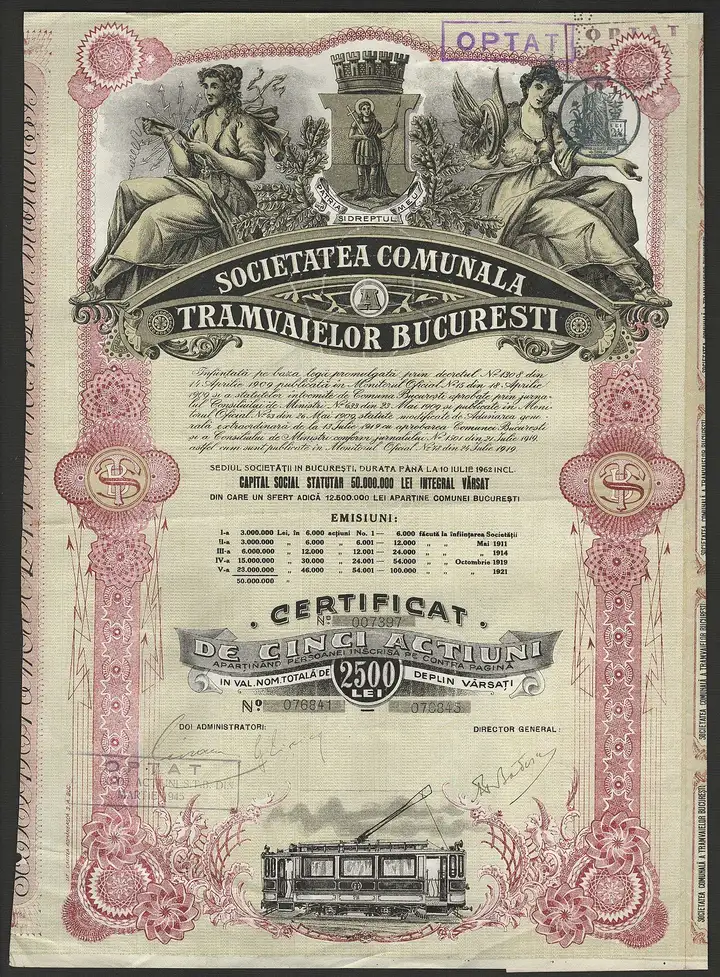
Share certificate of the Bucharest Municipal Tramway Company, 24 July 1919
Share certificate of the Bucharest Municipal Tramway Company, 1919 · Photo: scan by EDHAC e.V., Wikimedia Commons, public domain

1924-1930

Before taking the controls, the tram driver went through the psychology lab

In the 1920s, the Bucharest tram company opened its own psychology laboratory. STB dates its founding to 1924 and presents it as the first applied experimental psychology laboratory in Romania. Historians of work psychology place it in 1925, as the first psychotechnical laboratory of the Bucharest Tramway Company, headed by P. Tomescu.

The aim was to select tram drivers. Examinations were individual and assessed the attention and dexterity the job required. In one test, described by STB, the candidate had to guide a needle along a winding track without leaving it; in another, to pass a ring over five tubes, with every touch lighting a red bulb. Those who failed were advised to look for another trade.

The results were presented in 1930 at a national congress, in a report on the professional selection of vehicle drivers: tram operators, chauffeurs and locomotive drivers. Several instruments, including an electric tachistoscope from 1928, are preserved in the STB exhibition.

Sources 515253

  1. 1869

    Tram Timișoara

    Romania's first horse-drawn tram

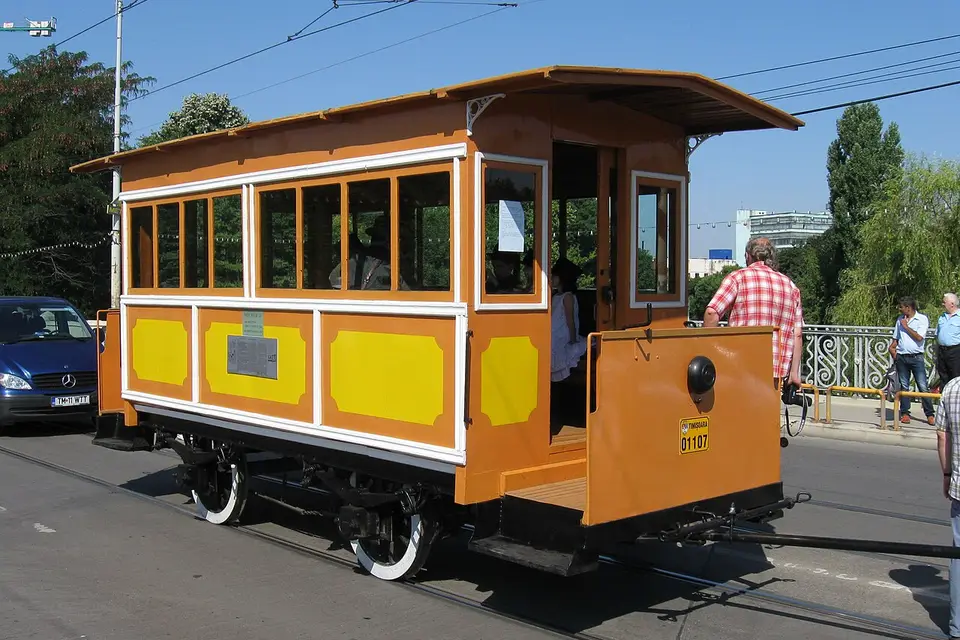
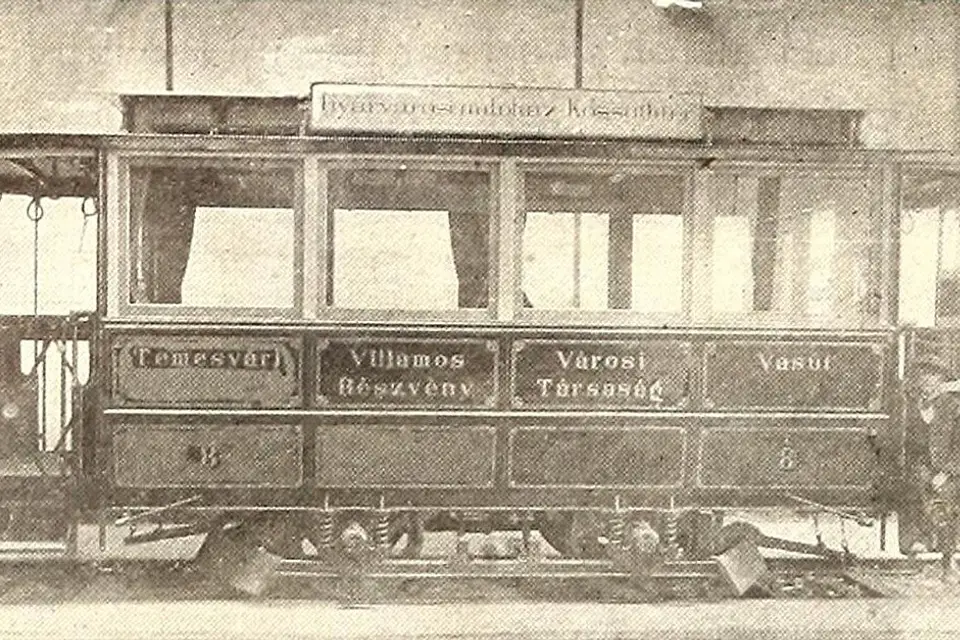
    Timișoara's first horse-drawn tram line opened on 8 July 1869, between Cetate and Fabric, as far as the Regina Engleză inn. It was run by the Temesvári Közúti Vaspálya Rt. (Temesvár Street Railway Company), founded in 1867; the concession was granted in 1868 and construction began in the autumn of that year. The passenger cars were built in Vienna and had wooden benches, and the line to Iosefin opened in October 1869. Horse traction was replaced by electric traction in 1899, and the network passed to municipal administration in 1904.1234

    Replica, 2011 · Photo: Turbojet, CC BY-SA 3.0
  2. 1869

    Tram Arad

    Arad gets a horse-drawn tram

    Arad received a horse-drawn tram in 1869, shortly after Timișoara, on 24 October 1869. The network had three lines and 19 cars, each pulled by one horse, and the first line linked the railway station with a factory on the bank of the Mureș. It was operated by the Societatea pe Acțiuni de Cale Ferată și Fabrică de Cărămidă (a joint-stock railway and brickworks company). In 1913 the municipality took over the network and in 1914 mechanical traction was introduced; the trams were requisitioned by the army in 1916.563

  3. 1872

    Tram Bucharest

    The horse tram reaches Bucharest

    The concession for Bucharest's horse tram dates from 1871, and the first line entered service on 28 December 1872, between Calea Moșilor and Piața Sfântul Gheorghe and between Piața Sfântul Gheorghe and Calea Griviței, with the Gara de Nord as a key point. At the start seven cars ran on the main line, each with ten seats, and in 1883 thirteen new cars arrived from Philadelphia. The network reached about 20 km of track; the last horse was withdrawn from service in 1929.378

    Photo: public domain
  4. 1893

    Tram Cluj

    A steam tram in Cluj

    Cluj's steam tram was operated by the company Kolozsvári Közúti Vasút Rt. and carried both passengers and freight. At opening it had three locomotives, six passenger cars and five open freight platforms, and in 1894 three more locomotives and two cars were added. The line ran from the railway station square towards the centre and was later extended along Calea Mănăștur to the former Ursus brewery. Service stopped on 15 May 1902 and the rails were not fully removed until 1909; accidents and poor financial results are given as the reasons.91011

  5. 1894

    Tram Bucharest

    Bucharest's first electric tram

    The capital's first electric tram entered service on 9 December 1894 on the route Cotroceni - Piața Sfântul Gheorghe - Calea Moșilor - Obor, over about 6.5 km. The Obor of that time lay in the area of today's Piața Iancului. The line was numbered 14 because the city already had 13 horse-drawn lines, and the cars were painted green. Electrification met resistance on the municipal council, notably on the grounds that the horses would be left without purpose; mayor Barbu Ștefănescu Delavrancea nevertheless defended electric traction.1271314

  6. 1899

    Tram Timișoara

    Timișoara switches to electric trams

    An electric tram replaced horses in Timișoara in 1899, after three decades of animal traction. Local sources state that the first electric cars came from the Ganz factory in Budapest, and the line already ran through Piața Libertății towards Piața Traian. In 1904 the company passed to city administration under the name Timișoara Communal Trams.151617

    Photo: public domain
  7. 1900

    Tram Iași

    Iași, the country's longest tram network

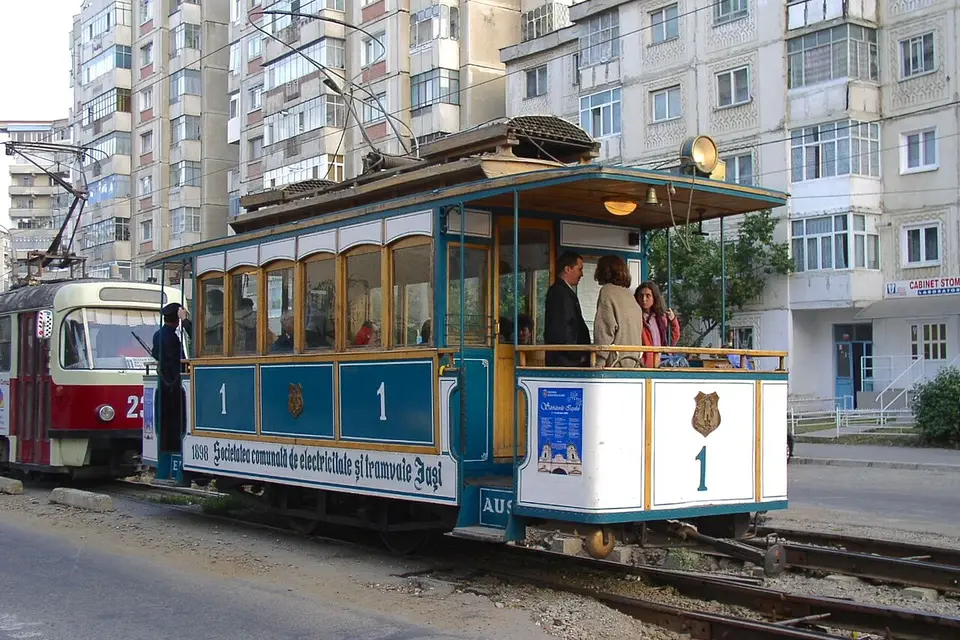
    In Iași the concession for an electric tram was put to tender in 1897, law 713 was signed by King Carol I in 1898, and the contract with AEG of Berlin was concluded on 31 March 1898. The first line, Central Station - Market Hall, was inaugurated on 1 March 1900 with 16 passenger cars, and routes to Păcurari, Socola, Nicolina, Copou and the Slaughterhouse were opened the same year. In 1900 the network measured about 17.3 km, the longest in the country at that time, compared with Brăila (13.4 km), Galați (13.2 km) and Timișoara (10.3 km). Electric trams also started in Brăila (25 June) and Galați (26 June) in the same year.181920

    Replica, 2005 · Photo: Tiberiu Sufitchi, public domain
  8. 1906

    Tram Oradea

    Electric trams in Oradea

    Oradea's first electric tram test run took place on the evening of 1 March 1906, between Primăriei and Independenței streets. The start of service was described by the newspaper Nagyvárad on 25 April 1906, which noted that the whole city had rushed to see the tram: over 5,100 tickets were sold on the first day in a city of about 55,000 inhabitants. The first electrified lines were installed by Siemens, and the original cars were withdrawn between 1924 and 1933. The city's power plant was extended the same year to supply the trams.212223

    Original 1906 car · Photo: Szilas, CC BY 4.0
  9. 1913

    Rail Arad, Podgoria

    The electric line through Arad's vineyards

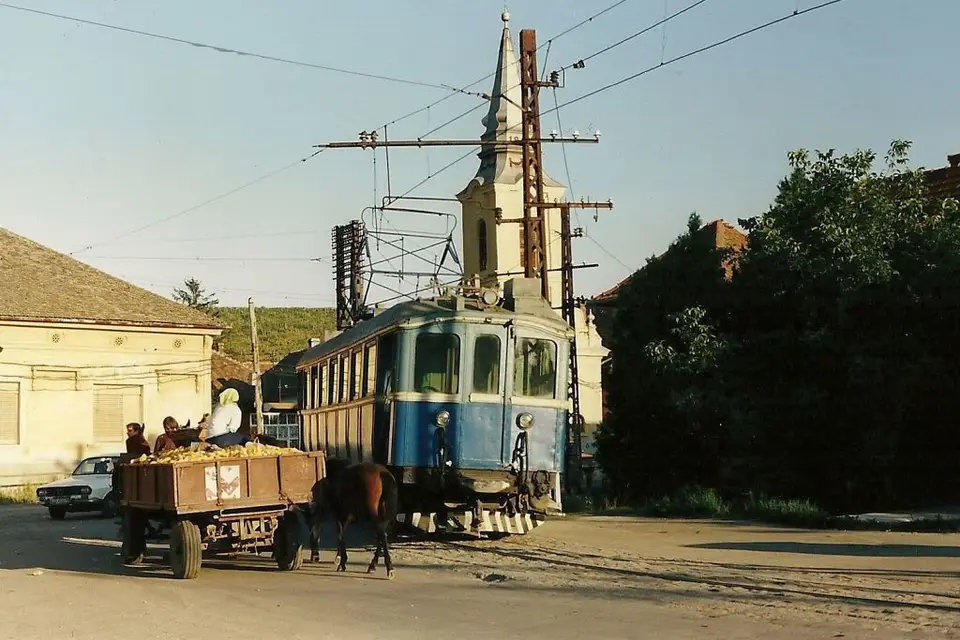
    The narrow-gauge (1000 mm) Arad - Podgoria railway, known as the 'Green Arrow', opened in 1906 with 58 km of line on three branches: Arad - Ghioroc, Ghioroc - Pâncota and Ghioroc - Radna. Passenger trains were hauled by Weitzer petrol-electric railcars built in Arad, while freight trains used steam locomotives. Electrification, carried out in 1911-1913, entered service on the Arad - Ghioroc section in April 1913; local sources present it as the first electrified railway in south-eastern Europe. The Ghioroc - Pâncota and Ghioroc - Radna branches closed on 1 October 1991, while the Arad - Ghioroc section remains in use.24252627

    Arad, 1995 · Photo: Oliver Wileczelek, CC BY-SA 3.0
  10. 1936

    Bus Bucharest

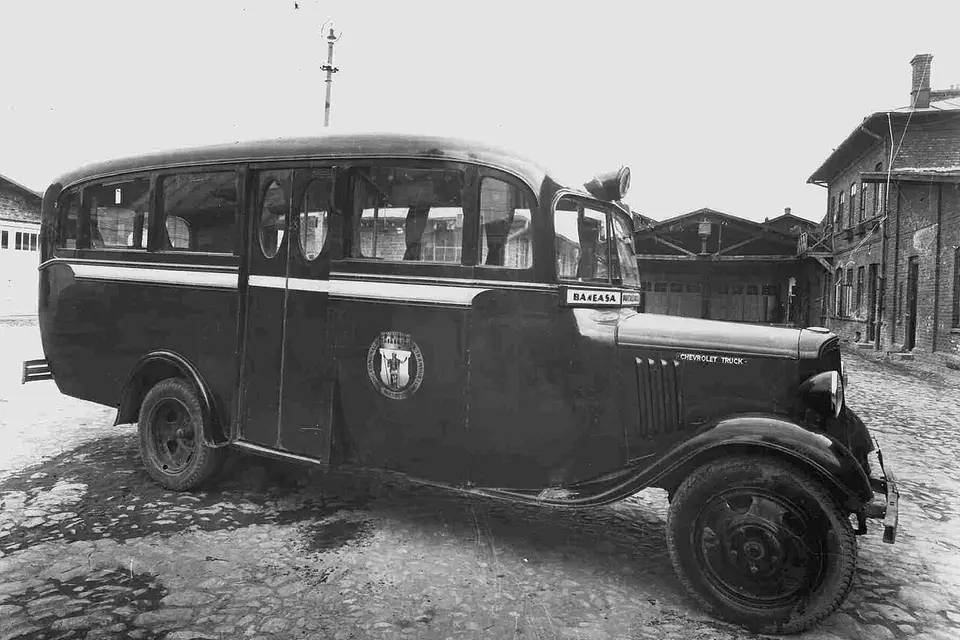
    392 buses in the capital

    In 1936 the Societatea Comunală pentru construcția și exploatarea tramvaielor în București (STB) obtained the exclusive right to operate public transport by tram and bus in the capital and 12 suburban communes. The bus fleet numbered 392 vehicles, built by Leonida & Co. on Renault, Chevrolet and Henschel chassis, running on 22 routes totalling 131 km of double track. The first bus attempts, made by small private companies in 1921 and 1924, did not withstand competition from the trams.2887

    Photo: public domain
  11. 1949

    Trolleybus Bucharest

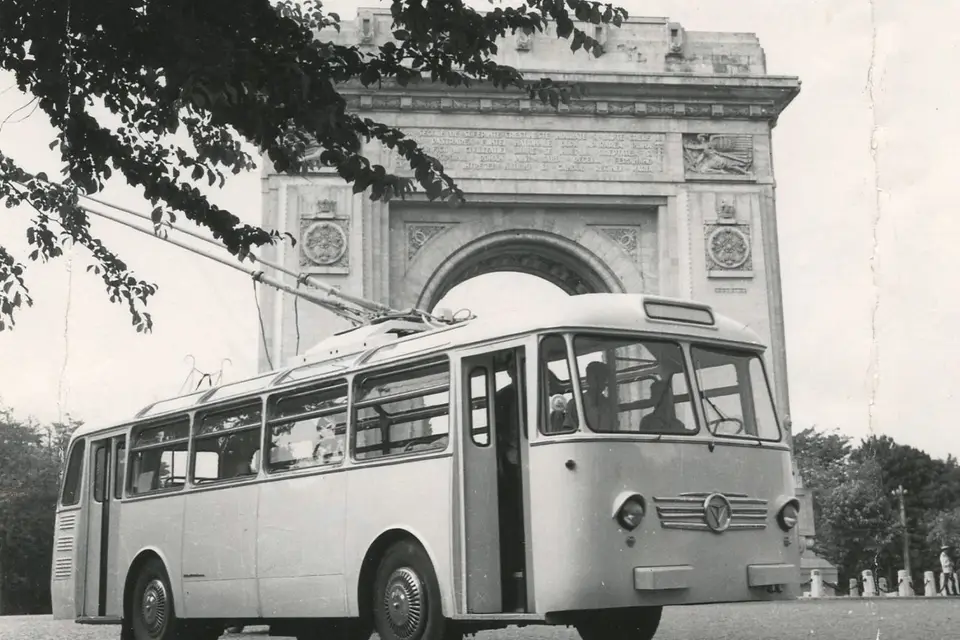
    The first trolleybus

    On 6 November 1949 Bucharest's first trolleybus line was inaugurated along Șoseaua Kiseleff, between Piața Victoriei and the Hippodrome (today Piața Presei Libere). Passenger service began on 10 November 1949. Five Soviet MTB-82D trolleybuses ran on it, built at Plant No. 82 in Tushino and first numbered 601-605, later 4001-4005. The press of the day described the opening as a show of „Romanian-Soviet friendship”.298

    T.V. 2E trolleybus, Bucharest, 1958 · Photo: Muzeul Național de Istorie a României, free use with attribution
  12. 1979

    Metro Bucharest

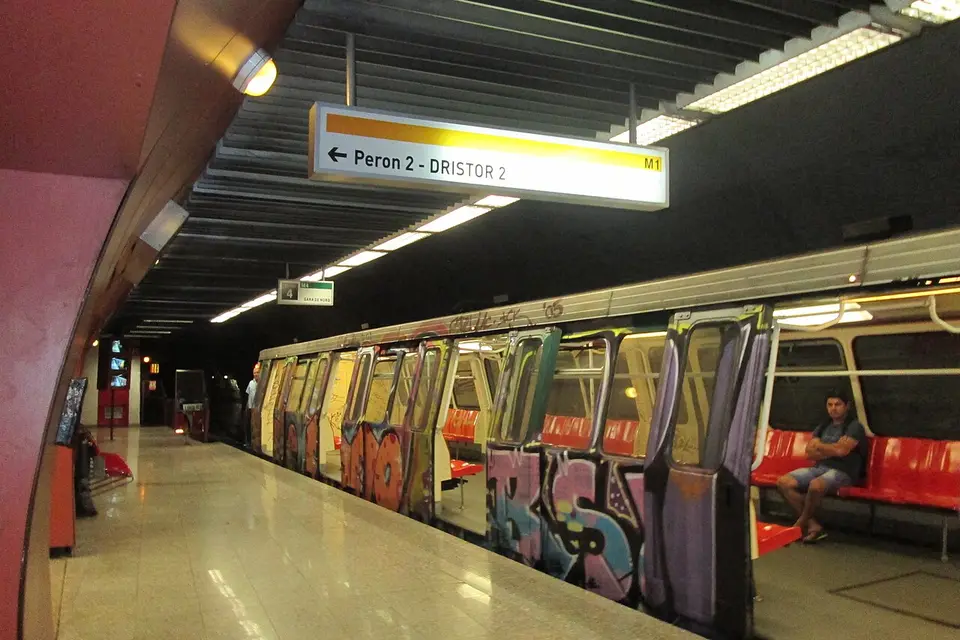
    The metro opens

    Construction of Bucharest's first metro section began on 20 September 1975. On 16 November 1979 the Semănătoarea (today Petrache Poenaru) - Timpuri Noi section entered experimental service, with six stations: Semănătoarea, Grozăvești, Eroilor, Izvor, Piața Unirii and Timpuri Noi. About 175,000 Bucharesters rode it on the first day, at a fare of 1 leu, and the trains had been built in Arad. The official inauguration, attended by Nicolae Ceaușescu, took place on 19 December 1979.303132

    Astra IVA train · Photo: TrainSimFan, CC BY-SA 4.0
  13. 1984

    Tram Constanța

    Trams return to Constanța

    In 1984 the tram returned to Constanța after a gap of about 40 years, since the 1943-1944 network that used vehicles taken from Odesa. The first line, 100 (Gară - Sat Vacanță), was served by 10 ITB V3A Classic articulated trams; lines 101 and 101B followed the same year and line 102 in 1986. The transport company was then called Întreprinderea Județeană de Transport Local. The network was closed in stages between 2004 and 2008, with the last lines, 102 and 101, stopping in October and November 2008.3334

  14. 1987

    Tram Ploiești, Craiova

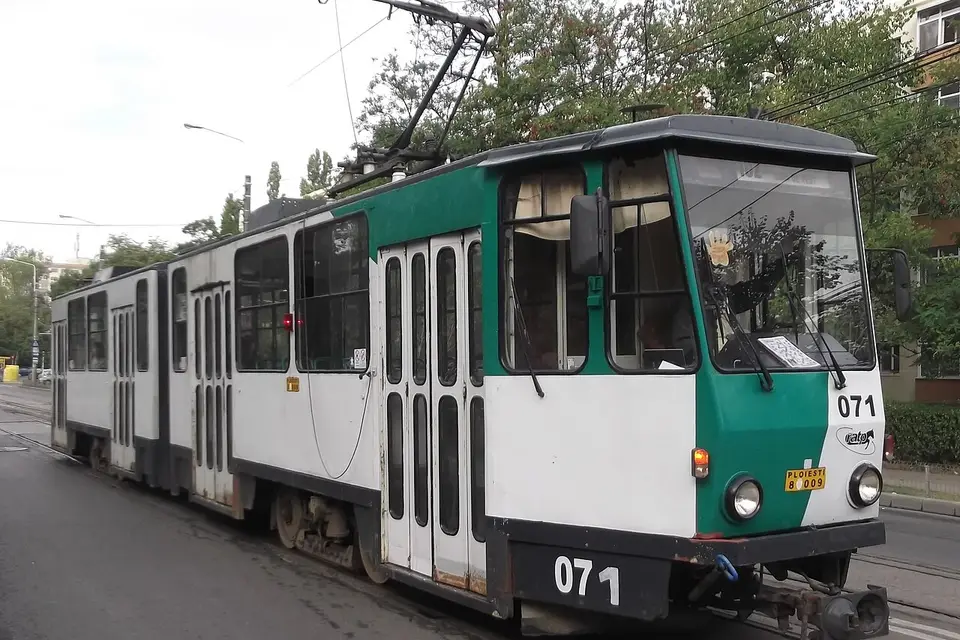
    Trams arrive in Ploiești and Craiova

    On 6 October 1987 the first tram entered service in Ploiești, on the first section Spitalul Județean - Gara de Sud, with about 9 km of track; works had begun in 1985, and before 1989 the city had reached six lines. In the same year, 1987, trams were introduced in Craiova, on a 18.4 km double-track route linking the city's eastern and western industrial areas. By 1989 Craiova had a fleet of 49 trams with trailers.3536

    Ploiești, 2012 · Photo: Stefan Puscasu, public domain
  15. 1990

    Bus Bucharest

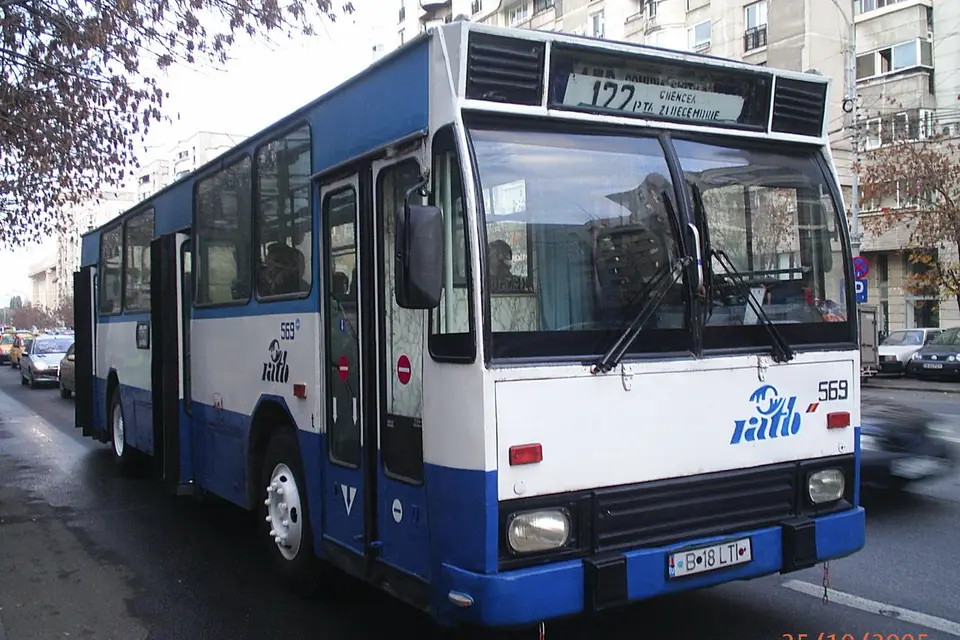
    ITB becomes RATB

    In 1990, by a decision of Bucharest City Hall, the Întreprinderea de Transport București (ITB, created in 1950 from the municipal tram company) became the Regia Autonomă de Transport București (RATB). The RATB name was used until 2018. In September 2018 the authority was converted into a joint-stock company and returned to its historical name, Societatea de Transport București (STB SA). According to press reports, the shareholders are Bucharest City Hall, through the General Council, and Ilfov City Hall, through the County Council.8373839

    RATB DAC bus · Photo: Stefan Puscasu, public domain
  16. 2020

    Metro Bucharest

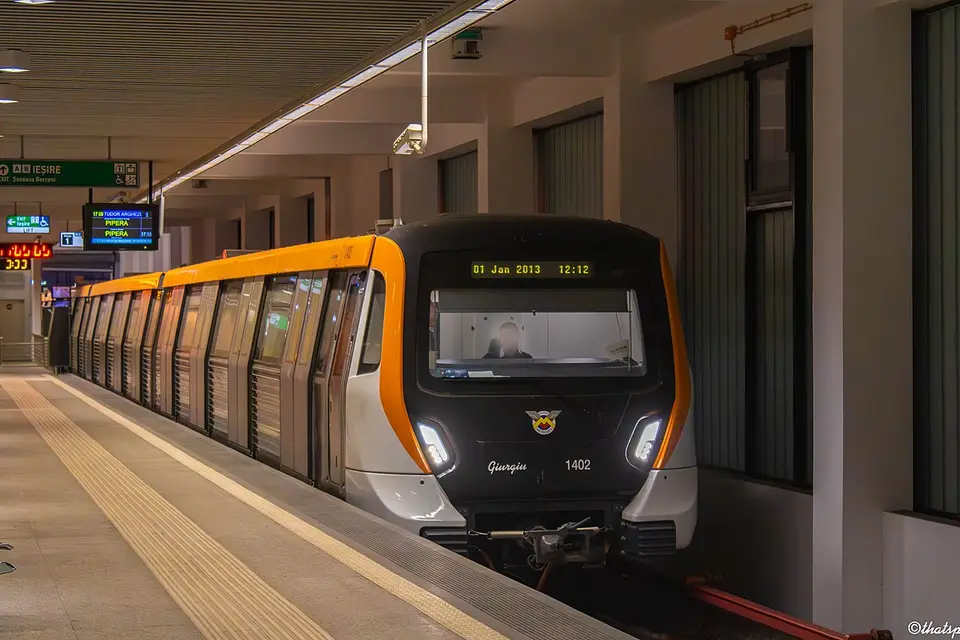
    Line M5, the first new line in 20 years

    On 15 September 2020, after 14:00, Magistrala 5 (line M5) entered service on the Râul Doamnei - Eroilor section, with ten stations and a depot at Valea Ialomiței, over about 7 km. Works had begun in November 2011, and the original deadline was 2014-2015. The total project value exceeded 3 billion lei, with the EU Cohesion Fund covering about 85% of the eligible value. The inauguration was attended by President Klaus Iohannis and Prime Minister Ludovic Orban, and trains can reach 80 km/h.404142

    Photo: Ionuț Ciurea, Asociația Pro Infrastructură, CC BY-SA 4.0
  17. 2022

    Tram Bucharest

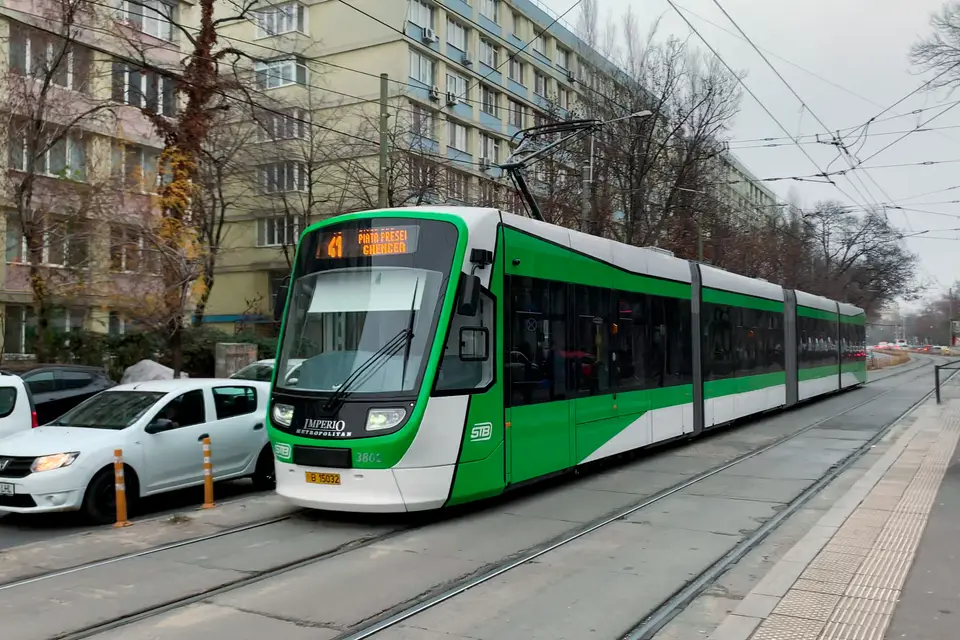
    The first Imperio trams

    On 10 December 2022 the first 15 Astra Imperio Metropolitan trams entered service on line 41 (Ghencea - Piața Presei), the first part of a contract for 100 trams with Astra Vagoane Călători of Arad. The vehicles are 36 m long, low-floor, and carry 322 passengers, 56 of them seated. They were the first new trams bought by Bucharest City Hall in 33 years, and STB trained 91 drivers for them. The first on-route test took place on the night of 18-19 July 2022, between Militari depot and Alexandria depot.43444546

    Imperio tram on line 41, December 2022 · Photo: Mihnea Lazăr, CC BY-SA 4.0
  18. 2023

    Metro Bucharest

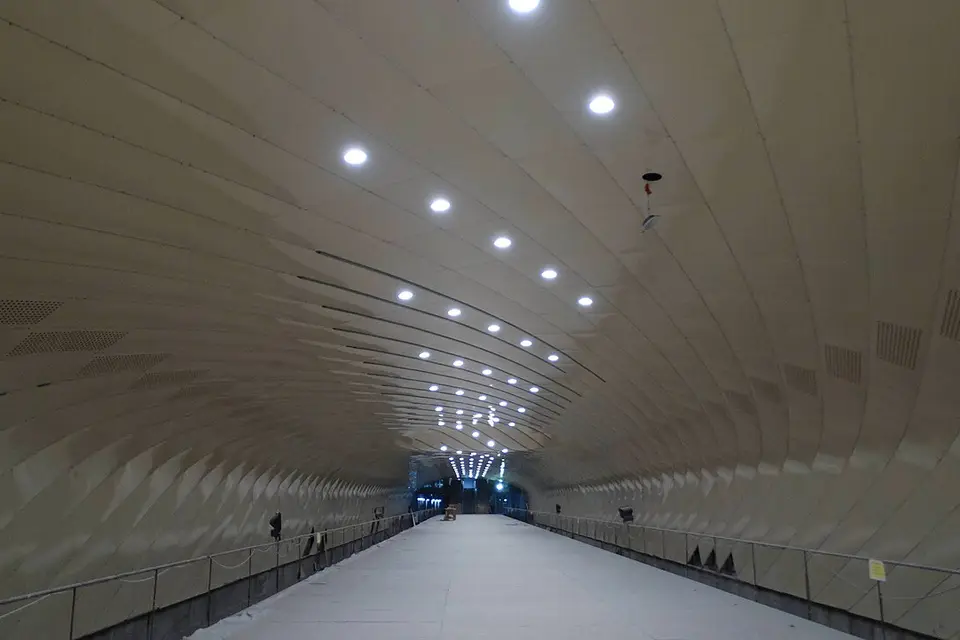
    Work starts on the airport metro

    On 15 December 2023 work began on Line M6, the 1 Mai - Tokyo section, the first of the 1 Mai - Henri Coandă International Airport project. The line is 14.2 km long with 12 stations and two sections, 1 Mai - Tokyo and Tokyo - airport. The first lot is being built by the Alsim Alarko-Makyol joint venture, and Tokyo station was to be built first. The updated project value exceeds 10.45 billion lei including VAT, and funding comes from the recovery plan (PNRR), the 2021-2027 Transport Programme, a loan from JICA (Japan) and the state budget.4748

    Alstom train on test, 2024 · Photo: Thatspongy, CC BY 4.0

From the archive: what the papers said

News about trams, trolleybuses, buses and the metro, from the papers of the day. The summaries are prepared by the editorial team; each links to the original page, digitised in public archives.

  • Monitorul Primăriei București, 20 December 1892

    Monitorul Primăriei București · 20 December 1892

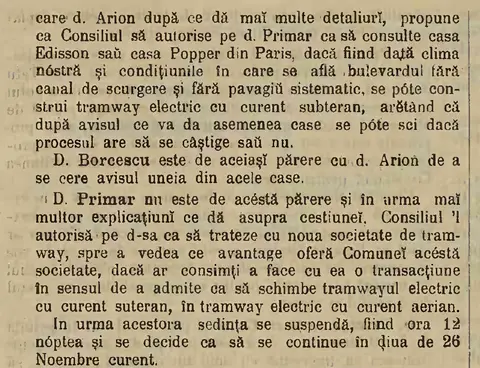
    The boulevard's electric tram: overhead wire or underground current?

    The tram concessionaires ask the city to drop the underground current promised on the Boulevard and use overhead wires instead. The debate kept the council busy for months.

    See the original paper →
  • Monitorul Primăriei București, 1 August 1893

    Monitorul Primăriei București · 1 August 1893

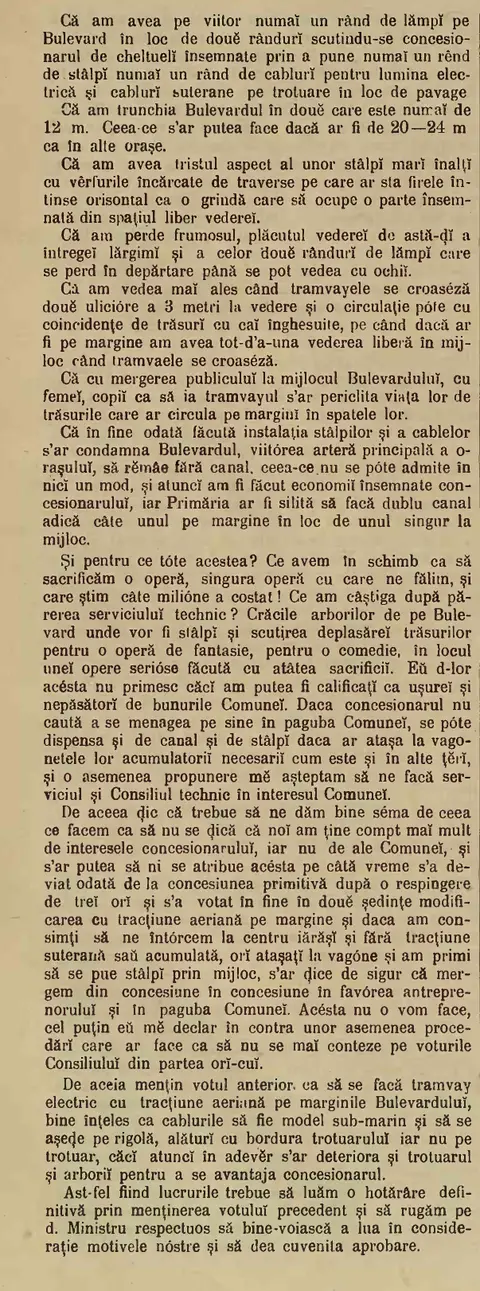
    The council cannot decide and sends the tram to the minister

    After a long debate about the electric tram system on the Boulevard, the city council refers the matter to the interior minister and asks for an outside expert opinion.

    See the original paper →
  • Adevărul, 26 August 1893

    Adevărul · 26 August 1893

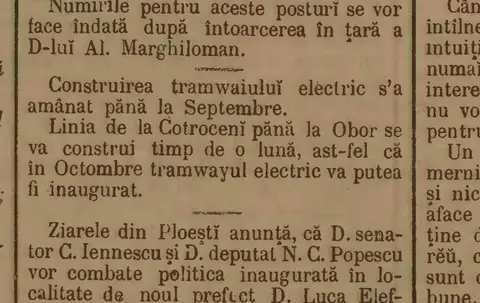
    "Electric tram ready in October"

    Adevărul reported that the capital's first electric tram could open in October. It actually started running only in December 1894.

    See the original paper →
  • Furnica · 23 August 1923

    The horse tram, slower than walking

    The satirical magazine Furnica mocks Bucharest's horse trams, slower than a person on foot, and compares them with the electric ones.

    See the original paper →
  • Gazeta de Transilvania · 7 August 1924

    Brașov: the tram timetable to Săcele and pickpockets on board

    The paper prints the Brașov - Noua - Dârste - Săcele tram timetable and a story about pickpockets caught on trains and trams.

    See the original paper →
  • Românul (Arad) · 8 January 1927

    Arad argues: buses or an electric tram?

    Arad debates whether the city needs buses or an electric tram, while the old steam tram comes in for criticism.

    See the original paper →
  • Informația Bucureștiului, January 1962

    Informația Bucureștiului · January 1962

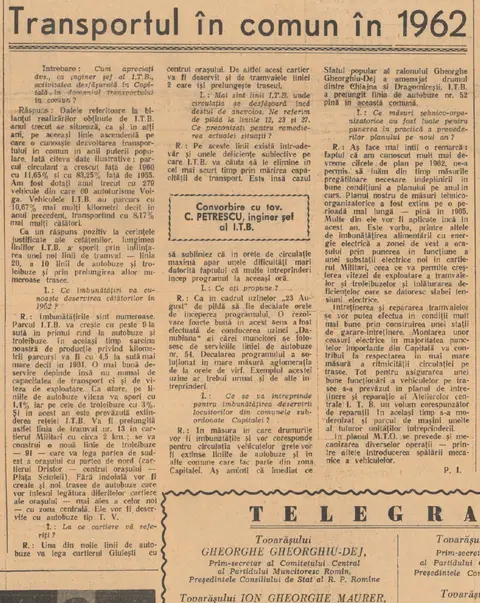
    ITB's 1962 plans: tram 13 to Militari, trolleybus 91 to Dristor

    ITB's management announces a 2 km extension of tram 13 into Militari and a new trolleybus route, 91, Dristor - centre - Piața Scânteii.

    See the original paper →
  • Informația Bucureștiului, March 1962

    Informația Bucureștiului · March 1962

    Trolleybuses have not recovered from winter

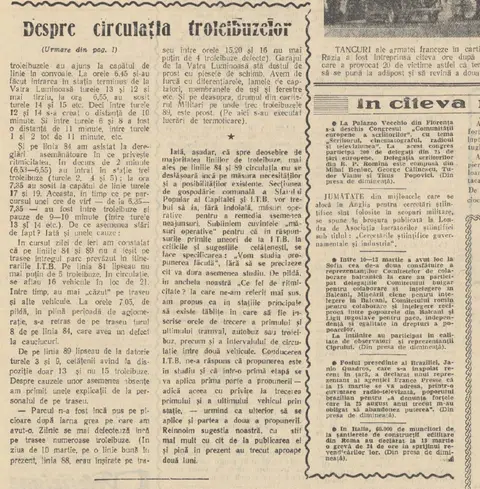
    A critical report: the trolleybus fleet has not recovered from winter, route 88 has many breakdowns and routes 84 and 89 run poorly.

    See the original paper →
  • Informația Bucureștiului, March 1962

    Informația Bucureștiului · March 1962

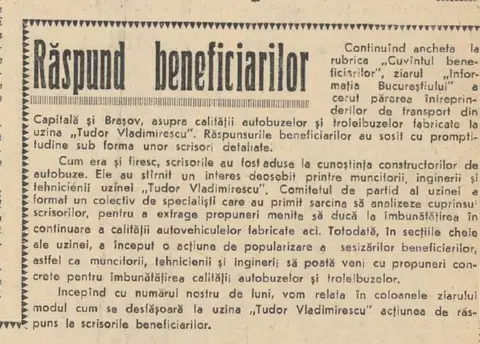
    What drivers think of the "Tudor Vladimirescu" buses

    The paper asks transport companies in Bucharest and Brașov what they think of the buses and trolleybuses from the "Tudor Vladimirescu" works, and the factory sets up a team to study the letters.

    See the original paper →
  • Informația Bucureștiului, February 1973

    Informația Bucureștiului · February 1973

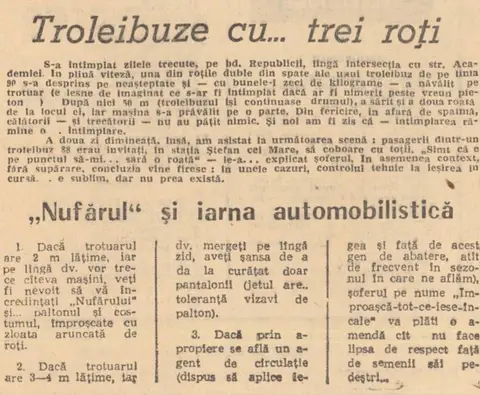
    "Trolleybuses on... three wheels"

    On Republicii boulevard a route 97 trolleybus loses its rear wheels and tips over. The passengers escape unhurt.

    See the original paper →
  • Mersul Trenurilor CFR, Summer 1977

    Mersul Trenurilor CFR · Summer 1977

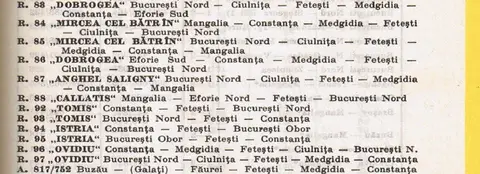
    Trains to the seaside had names: Tomis, Istria, Ovidiu

    The summer 1977 timetable lists named trains to Constanța, such as Tomis, Istria, Ovidiu or Mircea cel Bătrân, leaving from Gara de Nord and Obor.

    See the original paper →
  • Informația Bucureștiului, January 1984

    Informația Bucureștiului · January 1984

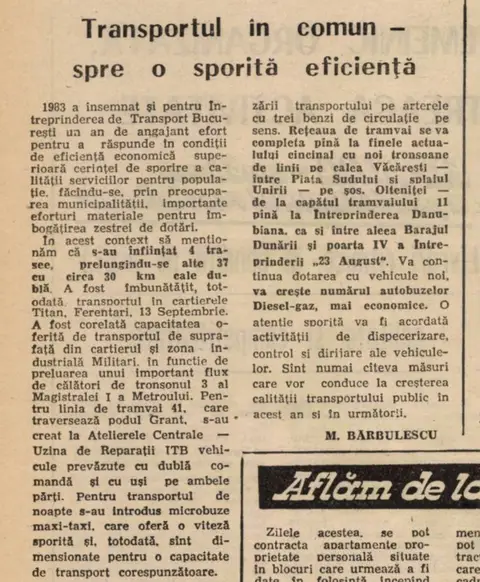
    ITB's 1984 plan: trams over Grant Bridge and night minibuses

    ITB announces connections to section 3 of metro line 1, tram 41 over Grant Bridge with double-ended vehicles, and maxi-taxi minibuses at night.

    See the original paper →
  • Informația Bucureștiului, February 1984

    Informația Bucureștiului · February 1984

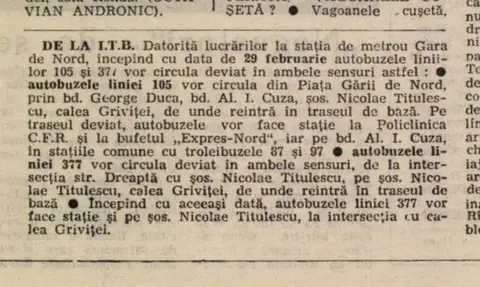
    Buses diverted for the Gara de Nord metro station

    From 29 February buses 105 and 374 are diverted because of works on the Gara de Nord metro station.

    See the original paper →
  • Informația Bucureștiului, January 1985

    Informația Bucureștiului · January 1985

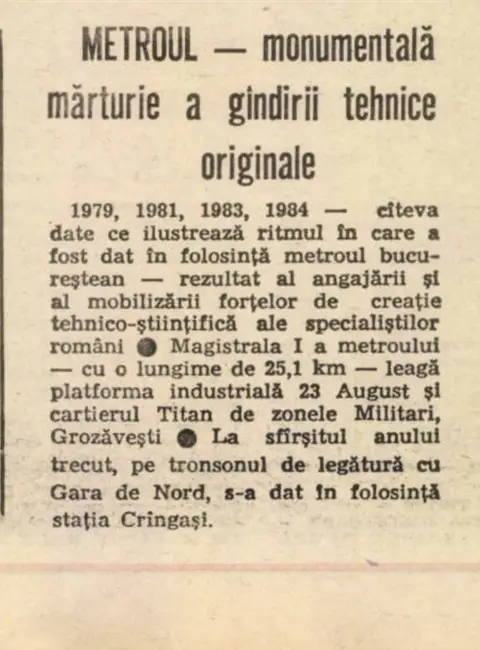
    The metro's record: 25 km on line 1

    In the capital's annual review, the metro is listed as opened in sections in 1979, 1981, 1983 and 1984. Line 1 is 25.1 km long and Crângași station opened at the end of 1984.

    See the original paper →
  • Informația Bucureștiului, February 1985

    Informația Bucureștiului · February 1985

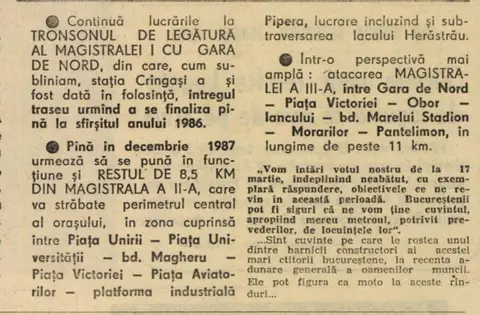
    The plan: line 2 to Pipera by December 1987

    Line 1's link to Gara de Nord was due by the end of 1986, and the remaining 8.5 km of line 2, Piața Unirii - Universitate - Victoriei - Aviatorilor - Pipera, by December 1987. Line 3, over 11 km, would follow.

    See the original paper →

Sources

The works, archives, press articles and official documents consulted for this timeline. Links open in a new page.

  1. Regia de Transport Timișoara aniversează 145 de ani de la apariția în oraș a primului tramvai tras de cai, Financiarul
  2. Timișoara, the first city with horse-drawn trams on today's Romanian territory, Transylvania Now
  3. Când au apărut primele tramvaie în Țările Române, Newsweek România
  4. Timișoara horse-drawn railway, Wikipedia
  5. Tramvaiul din Arad, Wikipedia (ro)
  6. Arad's on the Rails, POLIS Network
  7. 115 ani de transport public în București, Radio România (rador.ro), 2024
  8. Istoria RATB din 1871, Historia.ro
  9. Cluj, codaș la tramvaie. Tramvaiele au fost puse în circulație în 1987, cu 100 de ani mai târziu față de celelalte orașe, Monitorul de Cluj
  10. Un tren cu aburi circula prin Piața Unirii în 1901, Știri de Cluj
  11. Tramvaiul din Cluj-Napoca, Wikipedia (ro)
  12. De la tramvaiul tras de cai la cel modern. Primul tramvai electric din București pornea acum 128 de ani, Gândul
  13. Paradă a tramvaielor electrice în Capitală, la 120 de ani de la prima linie electrică, Mediafax
  14. 9 decembrie, ziua în care bucureștenii vedeau minunea, Observator News
  15. Timișoara, primul oraș din Europa cu tramvaie electrice. O lecție de pionierat uitată, Efain la Timișoara
  16. Vechea linie de tramvai a Timișoarei descoperită întreagă pe șantierul arheologic din Piața Libertății, Adevărul
  17. STPT (transport operator), Wikipedia (en)
  18. Electric tram history (Regie), CTP Iași (sctpiasi.ro)
  19. S-au împlinit 121 de ani de la apariția primului tramvai pe străzile din Iași, BZI.ro
  20. List of town tramway systems in Romania, Wikipedia (en)
  21. FOTO Adus de la Viena, tramvaiul de epocă a pornit, Adevărul, 2016
  22. Aspecte privind modernizarea orașului Oradea. Sfârșitul secolului XIX - începutul secolului XX, Ziridava (CEEOL)
  23. Cum a trecut un oraș din România de la iluminatul cu gaz la cel electric, Adevărul
  24. Turiștii pot circula cu trenul electric de epocă „Săgeata Verde”, care a fost repus în funcțiune, Economica.net
  25. FOTO Au trecut o sută de ani de la prima cale ferată electrificată din România, Adevărul, Arad
  26. Calea ferată Arad-Podgoria - prima linie electrificată din estul Europei, Studii, Universitatea de Vest „Vasile Goldiș” din Arad
  27. Weitzer railmotor, Wikipedia (en)
  28. Istorie, Societatea de Transport București (stb.ro)
  29. Primul troleibuz din București circulă pe Kiseleff acum 75 de ani, Newsweek România
  30. Povestea metroului românesc. Între nevoie și ambiția lui Ceaușescu, Europa Liberă România
  31. 19 noiembrie 2018, 39 de ani de la inaugurarea oficială a primului tronson de metrou din București, Wall-Street.ro
  32. Gata cu panglica, mai rămâne construcția, Adevărul
  33. Desființarea ultimelor linii ale tramvaiului din Constanța, Infopolitica
  34. Tramvaiul din Constanța, Wikipedia (ro)
  35. 6 octombrie 1987: ziua în care ploieștenii au văzut pentru prima dată „Ampicilina” umblând pe șine, Prahova Business
  36. Istoria RAT Craiova, Craiova Veche
  37. Expoziția STB (denumiri: STB, ITB, RATB 1990-2018, STB din 2018), STB
  38. Gabriela Firea: RATB s-a transformat oficial în Societatea de Transport București SA, Mediafax
  39. RATB, transformată oficial în societate pe acțiuni, Bursa.ro
  40. Metroul Drumul Taberei, inaugurat de Iohannis și Orban. Magistrala M5, finalizată după 9 ani, Știrile ProTV
  41. Este oficial: Magistrala de metrou Drumul Taberei - Eroilor s-a deschis, Ziarul Financiar
  42. Radiografia metroului din Drumul Taberei: după 17 miniștri, 8 directori Metrorex și 5 ani de întârzieri, M5 a fost deschisă, Mediafax
  43. Primele 15 tramvaie Imperio vor circula pe linia 41, începând de sâmbătă, G4Media
  44. Noile tramvaie Astra au ieșit pe traseu. Nicușor Dan: Este un moment de bucurie pentru București, Digi24
  45. STB a efectuat primele teste pe traseu cu noul tramvai Astra Imperio Metropolitan, Newsweek România
  46. Cum arată noile tramvaie Imperio care vor circula pe linia 41, Euronews România
  47. Încep lucrările la magistrala de metrou către aeroportul Otopeni, Euronews România
  48. Metroul spre aeroportul Otopeni întârzie, șoferii vor circula cu restricții încă cel puțin doi ani, Capital
  49. Din istoria transportului de călători în București (1962), capitolul despre tramvaiul cu vapori, după Arhivele Statului București, Primăria municipiului București, dosar 495/1906, Alexandru Cebuc, pp. 136-141
  50. Alexandrina Nicolae, Incursiune în viața Bucureștiului. Călătorind prin „Micul Paris”, București. Materiale de istorie și muzeografie, XVII (2003), Muzeul Municipiului București, pp. 240-241
  51. Expoziția STB, prezentare, STB
  52. Jurcău, Drugaș, File din istoria psihologiei muncii din România, Psihologia Resurselor Umane, p. 129
  53. STB a avut primul laborator de psihologie experimentală aplicată din România, NewsMedical